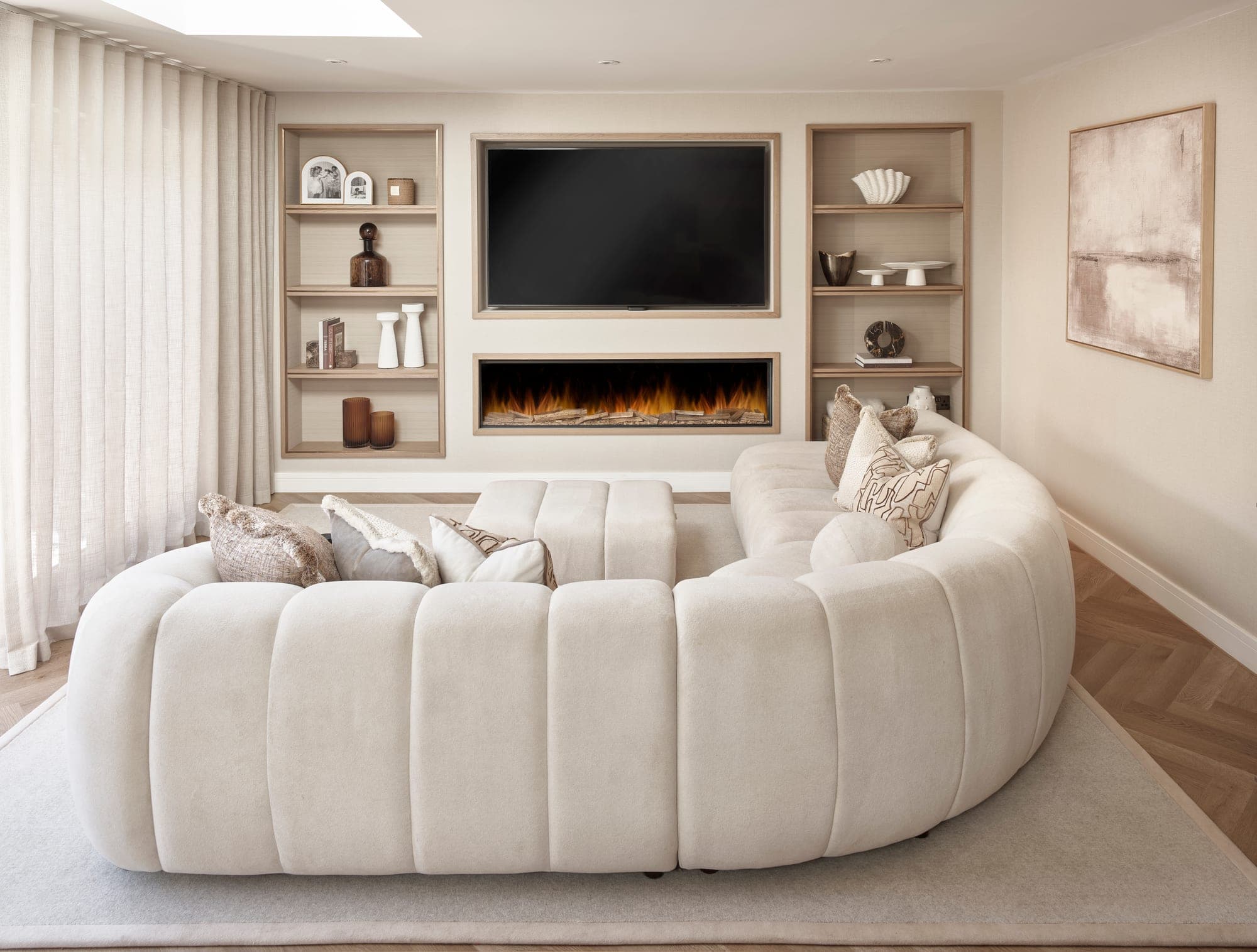

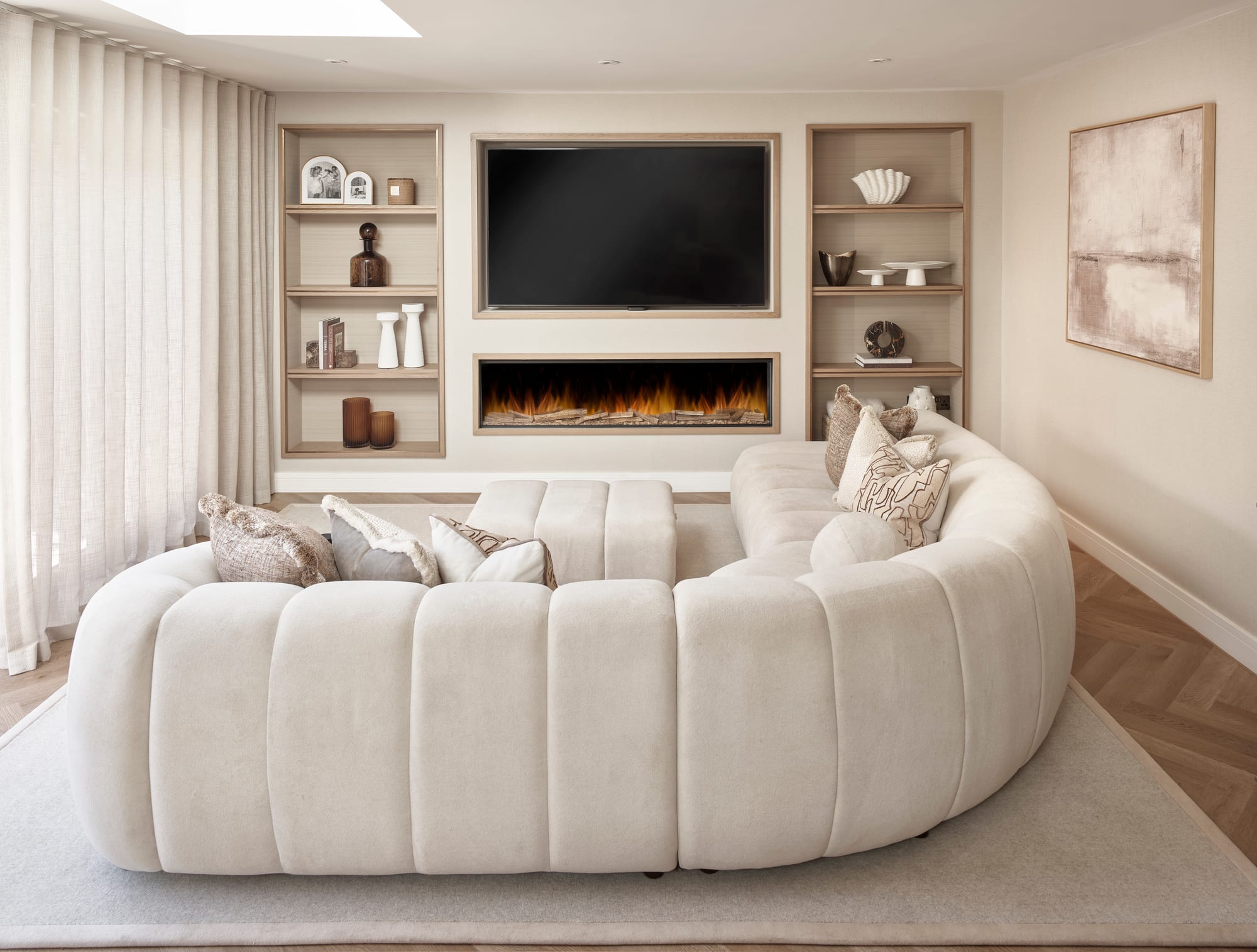
Media walls have picked up a bit of a reputation, and if I’m honest, a lot of them have earned it. You know the look: a slab of grey panelling, a vast television stuck on the front of it, a strip of flickering orange underneath, and the whole thing glued to a wall it clearly wasn’t designed for. Done like that, it dates in about eighteen months.
Done properly, though, a media wall is one of the most useful pieces of joinery you can put in a house. It takes the single ugliest object most of us own, gives it somewhere to live, and turns the wall everyone stares at into something worth staring at. We finished one in Timperley recently, and it’s a good example of the difference, so I’ve used it to illustrate what actually matters.
Start with the room, not the television
Almost every media wall that goes wrong goes wrong here. Someone buys a 75-inch screen, and the joinery gets designed around it, which means the proportions of the unit are set by a product rather than by the room.
Do it the other way round. Look at the ceiling height, the width of the wall, where the windows are, where you actually sit. Work out the proportions that suit the room, then find the screen that fits inside them. A slightly smaller television in a well-proportioned wall looks far more expensive than a huge one in a badly proportioned one. Nobody has ever walked into a room and thought it would be better with four more inches of screen.
Set the screen into the wall, not onto it
This is the single biggest thing, and it’s the one people skip because it costs more. A television hung on the front of a panelled wall still reads as a television hung on a wall. A television recessed into the joinery, so its face sits flush, stops reading as an object at all. It becomes a dark rectangle in a composition, which is a completely different thing to look at.
Recessing also solves the cables, which is the other thing that ruins these walls. If you are building the opening anyway, the sockets, the aerial, the HDMI runs and the drivers for the lighting all go in behind the plaster before anything is fitted. No trunking, no box of adaptors sitting on a shelf, nothing hanging down the wall.
You don’t have to have the fire
I’ll say this plainly, because it goes against everything you see on Instagram: the long electric fire under the screen is not compulsory. It has become a default, and a lot of people end up with one they never switch on.
Ask yourself honestly whether you want it. If the room already has a working fireplace elsewhere, or you’re someone who’d never think to turn it on, that money is better spent on the joinery, the lighting or a better screen. If you do want one, and plenty of people genuinely love them, buy a good one. The cheap ones give themselves away instantly by the colour of the flame and the plastic sheen of the logs.
In Timperley the fire earns its place, because that room is where the family actually sits in the evening and the wall is the thing you face. That’s the test. Not whether it looks good in a photograph.
Material is what dates, or doesn’t
Painted plasterboard dates. Not because paint is wrong, but because a painted media wall has nothing to hold your eye except its shape, so when the shape goes out of fashion, the whole thing goes with it.
What lasts is material. In Timperley the framing and shelves are oak veneer, the backs of the recesses are a textured wallpaper rather than flat paint, and there’s a 10mm bronze inlay running inside the framework and along the front edge of every shelf. None of that shouts. You notice it as warmth and depth before you notice it as detail, and that’s exactly the point. It gives the wall something to be other than its outline.
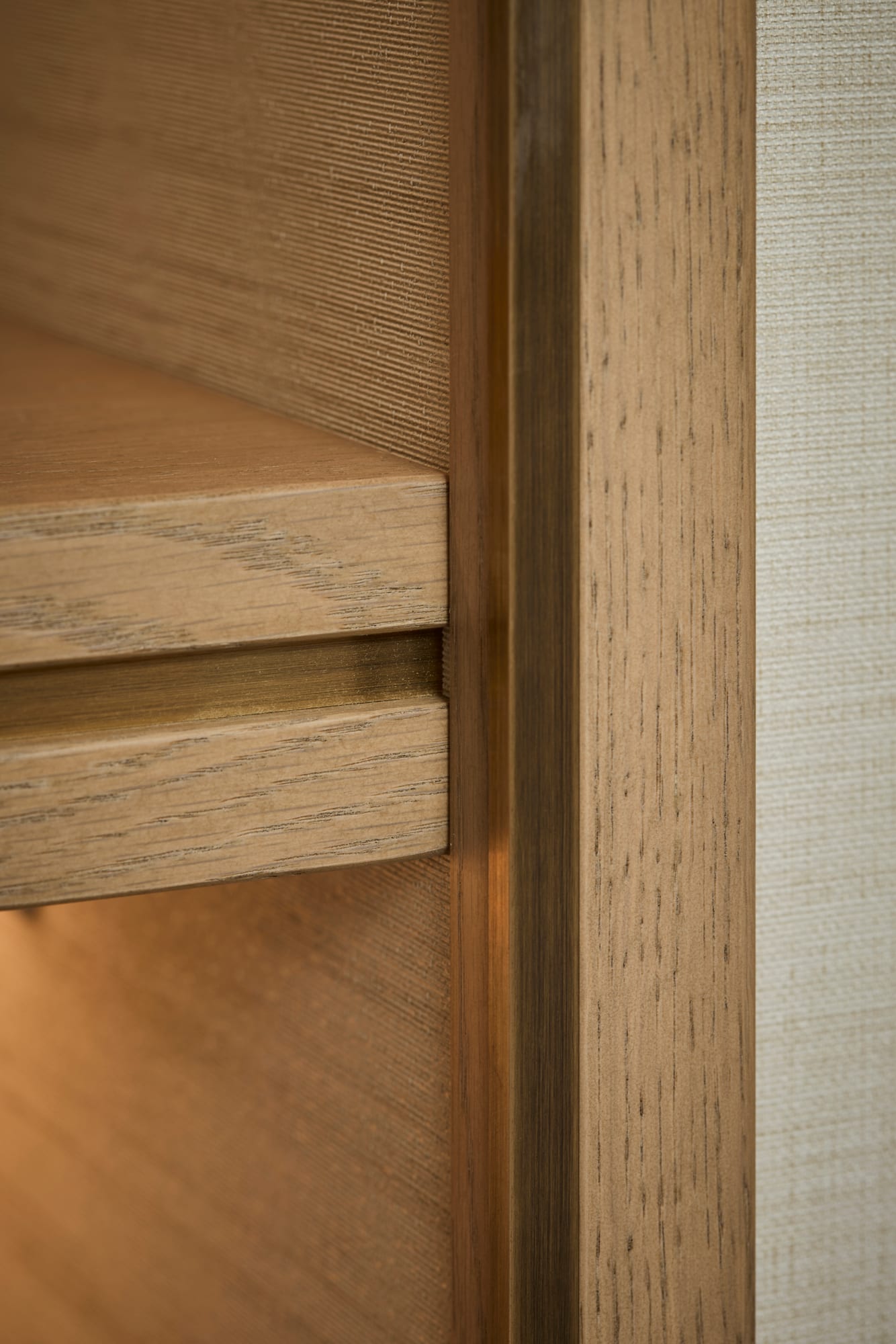
The texture behind the shelves does more work than anyone expects. A flat painted panel at the back of an alcove swallows light. A woven or textured surface catches it, so the recess has depth instead of looking like a hole.
Light the shelves, not the wall
Lighting is where most media walls either come alive or look like a bar. The rule I’d give you: light the shelves themselves, from within the joinery, so the material glows. Don’t wash the whole wall in LED strip, and please don’t put colour-changing lighting in it unless the room genuinely belongs to a teenager.
Get the lighting on a dimmer, and on its own circuit, separate from the ceiling lights. The whole point is that on a winter evening you can have the shelves and the fire on and everything else off. If it’s wired into the main room circuit you lose that completely. I’ve written more about layering light in how to light a room, and the thinking is the same here.
Leave room for real life
A media wall full of perfectly spaced ornaments looks like a showroom, and it lasts about a week before the remote controls and the chargers arrive anyway. Design for that. Some closed storage low down, shelves deep enough to hold actual books rather than decorative ones, and a bit of breathing room.
And when you style it, use fewer, larger things. Three good objects on a shelf look considered; nine small ones look like a car boot sale. It should look like someone lives there and has taste, not like it was arranged for a photograph and never touched again.
You can usually keep what’s there
This surprises people. A lot of homes, especially newer builds, already have some kind of media wall: flat niches in plasterboard, painted the same colour as everything else, with the screen on the front. It works, and it disappears.
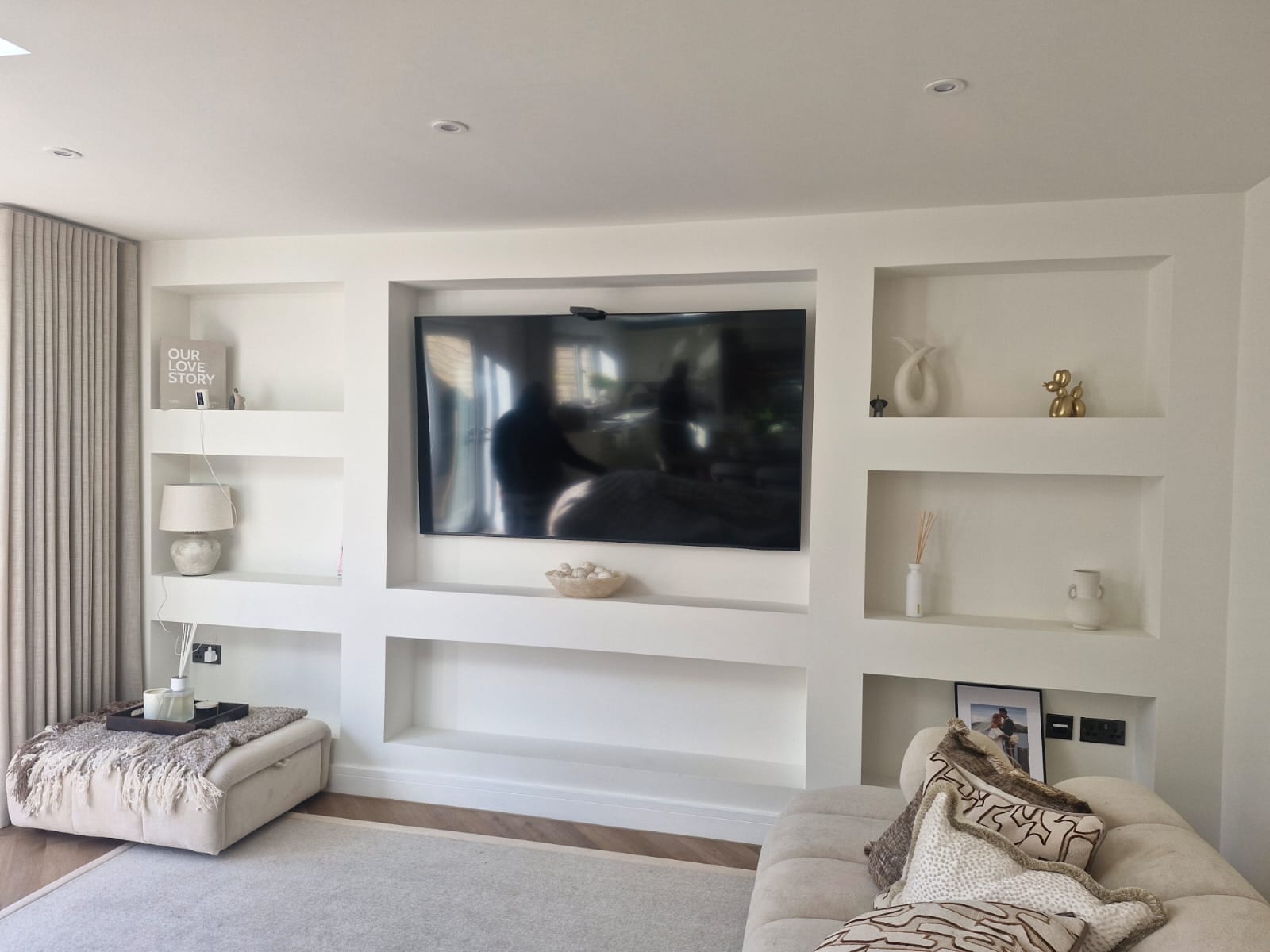
That’s exactly what was in Timperley, and the new wall sits in the same footprint. Nothing moved. The television is where it always was and the shelves hold what they always held. What changed is the material, the light, and the screen going into the wall rather than onto it. If you’ve got something similar, you may be closer to the finished thing than you think, and a retrofit is usually a much smaller job than starting from nothing. We wrote the whole Timperley build up in the work journal, concept drawing through to bare plaster and back out again, if you want to see what the stages actually look like.
So, is it worth doing properly?
A media wall is joinery, and the honest answer is the same one I gave about bespoke joinery generally. Done cheaply it’s a cost you’ll pay twice, because you’ll live with something that irritates you and then replace it. Done properly it’s the piece that makes the room feel finished, and it’s one of the few bits of a house that genuinely earns its money every single evening.
If you’re thinking about one, the best time to talk is before anything is ordered, while the proportions and the cabling are still decisions rather than facts. Get in touch and tell us about the room.